
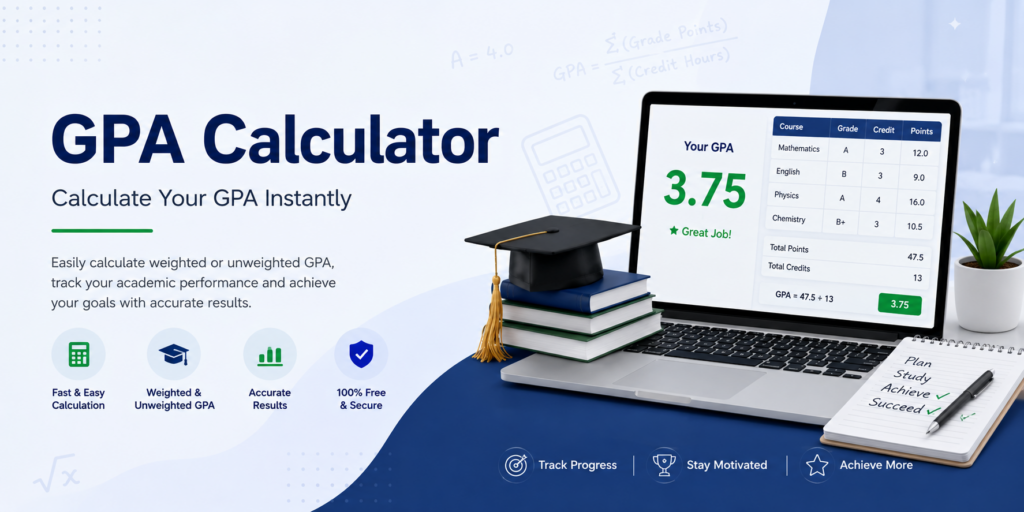
GPA Calculator
Your Cumulative GPA
A final grades calculator provides students with the ability to calculate how they are performing academically in a fast and accurate manner. Regardless of whether you are in high school, college or your senior year it is important to understand what your GPA is so you know how well you are doing and if to pass a grade especially if graduation relies on it and even for the future as having an accurate record of how much work effort! The calculator works by enabling users to track their grades, course credits and number of credit hours.
It then uses the GPA calculator to automatically calculate your GPA with the same grading formula most schools and colleges use.
A significant number of utilize calculators to assess their semester performance, estimate their overall GPA, or analyze potential might impact academic outcomes. Given that differ across institutions, it is prudent to consult school’s official grading policy prior to placing trust in estimation.
Try our Percentage Calculator to quickly convert marks into percentages before calculating GPA.
What Is GPA Calculator?
A GPA calculator is a handy little program that helps students analyze their performance on previous academic tracks. If you need help estimating a GPA, preparing for university applications or understanding why this tool can assist students make more strategic education decisions By taking advantage of monitoring grades, using credit hours effectively and learning how to study better, one is able to boost their academic status.
- A = 4.0
- B = 3.0
- C = 2.0
- D = 1.0
- F = 0.0
These are then multiplied by course credits giving total grade points earned. By performing the math involved in GPA calculations automatically and eliminating manual risk factors, the calculator saves time and effort.
GPA is commonly used in academic grading systems across schools and colleges worldwide.
How GPA Is Calculated
A clear grasp of the standard GPA calculation method empowers you to proactively monitor your academic journey and steer your progress.
GPA = Total Grade Points Earned ÷ Total Credit Hours
This means GPA is calculated by:
- Converting letter grades into grade point values
- Multiplying grade points by course credits
- Adding the total number of grade points
- Dividing the total number of grade points earned by the total number of credit hours attempted
In simple terms, GPA calculation involves dividing the total points earned by the total credit hours.
For instance:
| Course | Grade | Credit Hour | Grade Points |
| Math | A | 3 | 12 |
| English | B | 3 | 9 |
| Science | A | 4 | 16 |
Total:
- Total number of grade points = 37
- Number of credit hours = 10
GPA:
37 ÷ 10 = 3.7 GPA
This method is commonly used in Academic grading in the United States and other educational systems worldwide.
You can also use our Square Root Calculator for advanced mathematical calculations.
How to Calculate GPA Step by Step
Input Your Grades
Start by entering the letter grades received in each class or course.
Enter Credit Hours
Add the number of credit hours assigned to every course. Courses with more credits usually carry more weight in GPA calculations.
Select the GPA Scale
Choose the grading scale used by your school, such as the standard 4.0 GPA scale or another grading system.
Calculate GPA
The calculator will automatically multiply grade points by credit hours and calculate the final average GPA.
This process may seem technical at first, but most calculators complete it instantly after inputting your information.
Weighted vs Unweighted GPA
Different schools may use weighted or unweighted GPA systems.
Unweighted GPA
An unweighted GPA uses the standard 4.0 scale, where all classes have equal value regardless of difficulty.
Weighted GPA
A weighted GPA assigns extra value to advanced classes such as AP, Honors, or IB courses. These advanced courses involve more challenging coursework and may help students raise their GPA.
For example:
- Regular Class A = 4.0
- Honors Class A = 4.5
- AP Class A = 5.0
Because schools vary in grading methods, students should always review their official grading policies.
Semester GPA vs Cumulative GPA
Understanding the difference between semester GPA and cumulative GPA is important for tracking long-term performance.
Semester GPA
A semester GPA measures academic performance during one semester or academic term only.
Cumulative GPA
A cumulative GPA combines grades from all completed semesters and courses throughout a student’s academic journey.
Most colleges review cumulative results because they provide a broader picture of a student’s overall performance.
How Course Credits Affect GPA
Course credits wield a significant influence on GPA calculation. Typically, courses with a higher credit value carry increased weight compared to those with smaller allocations.
Prudent planning is paramount as advanced courses may elevate your cumulative GPA while lower grades can have a considerable impact Additionally institutions may implement distinct policies for repeated courses.
Some schools also account for repeated classes differently. In certain institutions, retaking a course may replace the original grade, while others may include both attempts in the transcript.
Can You Get a GPA Higher Than 4.0?
Yes, some schools allow GPAs higher than 4.0 through weighted GPAs.
Some classes, such as AP, Honors and IB courses may receive extra grade points. As a result, students in rigorous classes could receive GPAs above the 4.0 GPA scale.
Policies do vary from one institution to another, so students should look carefully at their school’s grading scale.
Do Electives and Pass/Fail Classes Count Toward GPA?
This depends on the grading system used by your school or college.
Some elective courses count fully toward GPA, while pass/fail classes may not affect the final grade point average at all.
Students should always review official academic policies to determine how these courses are treated in GPA calculations.
Can Retaking a Class Replace a Bad Grade?
Many colleges allow students to retake a course to improve academic standing.
In some cases, the new grade may replace the old grade. Other schools may average both grades together on the transcript.
Because policies vary, students should check with academic advisors before attempting grade replacement programs.
Calculate Your High School GPA
Students can also use this calculator to calculate your high school GPA.
To calculate your high school GPA accurately:
- Enter percentage grades or letter grades
- Add the number of credit hours
- Select weighted or unweighted scale
- Include final exam results if required by your school
High school grading systems can vary significantly between institutions, so always check the official guidelines.
Students can also use our Percentage Calculator to convert exam scores into GPA values.
Students should always review their school’s academic grading policies before calculating GPA.
Tips to Raise Your GPA
Elevate your GPA requires consistent effort rather than short-lived bursts. Here are some key strategies:
- Attend every class regularly
- Complete assignments on time
- Prepare early for each final exam
- Focus on high-credit courses
- Review weak subjects more frequently
- Ask teachers for clarification when needed
Even smaller improvements across several courses may positively affect overall GPA over time.
Why GPA Matters
GPA is often used to determine:
- Scholarship eligibility
- College admissions
- Academic certificates
- Graduation requirements
- Internship opportunities
- Academic standing
Institutions frequently evaluate a student’s GPA to gauge their sustained academic performance and developmental trajectory.
Many universities follow official college admission guidelines while reviewing student GPA performance.
FAQs
What is a good GPA?
Ans: A good GPA depends on your collages & schools In many colleges a GPA above 3.0 is considered strong.
How do colleges view weighted GPA?
Colleges Typically review both weighted & unweighted GPAs considering course difficulty and student performance to get a complete picture.
How often should I calculate GPA?
It’s best to calculate your GPA after each semester or term this allows you to consistently monitor your academic progress & address any potential concerns early.
Can GPA affect scholarships?
Yes, GPA can definitely impact scholarship eligibility in many scholarship programs student require to maintain a minimum GPA throughout the academic year to receive continue funding.
Many scholarship programs also consider percentage scores alongside GPA calculations. Percentage Calculator
Is GPA the only measure of academic success?
No, while GPA is important in schools & employers also consider a variety of other factors like skills , projects , experience & leadership and learning development.
In Conclusion
A GPA calculator is a handy little program that helps students analyze their performance on previous academic tracks. If you need help estimating a GPA, preparing for college admissions; understanding why this tool can assist students make more strategic education decisions By taking advantage of monitoring grades, using credit hours effectively and learning how to study better, one is able to boost his or her academic status.